Tuesday, 24 May 2011

Staying in Rome with the Hot Cross Bun Sisters

Whilst in Rome the interns stayed in the beautiful and very welcoming Casa Santa Brigida, located on Piazza Farnese in the heart of the historical centre of the city, and a few metres away from the English College. The Casa itself is a XV century building, in which the Sisters of the ‘Brigidine Order’ work tirelessly to make the stay of their guests a pleasant one. In the first floor of the house it is possible to visit the three rooms where Saint Bridget lived and died; other perks included the view from the roof terrace and the friendliness of the other guests.
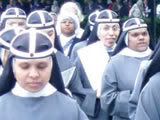
The 'Hot Cross Bun' Sisters! Can you see why?
For more information about this hotel and other hotels of the Brigidine order click here

Chris 
Brussels Intern

Accommodation in Rome, Casa Santa Brigida, Piazza Farnese

Thursday, 5 May 2011

Visit to Rome

Early on Monday morning, the interns will be on their way to the airport for a once in a lifetime trip to Rome.
The visit is packed full of exciting meetings with important people in the Vatican, Mass in St Peter's Basilica, a tour of the Vatican Gardens and some free time to explore this beautiful city.

Casa Santa Brigida - our accommodation in Rome
After arriving mid-morning and settling into our accommodation for the three days we are in Italy's capital city, we will meet Fr John Paul Leonard who is the Pastoral Director of the Venerable English College which is next door to Casa Santa Brigida for a tour of the College and Mass.     
After lunch we have a meeting with   Lesley-Anne Knight who is the Secretary General of Caritas Internationalis. Prior to her appointment, she was International Director of CAFOD, the Caritas member in England and Wales and in the course of more than 25 years in international development, she has also worked with the United Nations High Commission for Refugees (UNHCR), Oxfam, and HelpAge International. As Secretary General of Caritas Internationalis, Lesley-Anne Knight manages the General Secretariat in the Vatican City, and the confederation’s delegations to the United Nations in New York and Geneva.
Following this, we are meeting Monsignor Philip Whitmore from the Secretariat of State. The Secretariat of State is the oldest and most important dicastery of the Roman Curia and is the pre-eminent department of the Vatican. Cardinal Bertone, the current Secretary of State is seen as the Prime Minister of the Vatican, the deputy to the Pope and is in charge of the political and diplomatic activities of the Holy See. Mgr Philip Whitmore is a priest of the Westminster diocese and works on translation and papal speeches within the Secretariat.
We are planning to meet up with Peter Stoddart, Catholic Parliamentary Intern last year, who is in his first year training for the priesthood at the Venerable English College, for dinner in the evening.
The stunning Vatican Gardens
After Mass celebrated by Fr John Paul Leonard first thing on Tuesday morning, we have more meetings lined up.  We are meeting Fr Federico Lombardi, director of the Vatican Press Office and Irish priest, Mgr Paul Tighe, who is the Secretary of the Pontifical Council for Social Communication.  In the afternoon, we are walking through the beautiful Vatican Gardens to the Pontifical Academy of Sciences to meet the Chancellor of the university, Bishop Marcelo Sanchez Sorondo.  In the evening, we have been invited to dinner at the British Embassy to the Holy See hosted the Deputy Head of Mission.
Early on Wednesday morning we are going to Mass at St Peter’s Basilica followed by meetings at the Pontifical Council for Justice and Peace and the Pontifical University of St Thomas Aquinas. After some free time on Wednesday afternoon, sadly we have to return to London.

St Peter's Basilica
I am incredibly excited about our visit to Rome. This really is a breathtaking list of inspiring people that we are meeting. We are extremely grateful for the unique opportunity we have been given as Catholic Parliamentary and Public Affairs interns to do this and I sincerely hope that we the make the most of it.
During our time in Rome we will be interviewing some of the people we meet and taking lots of pictures – so watch this space when we get back!  


Naomi Brandon
Public Affairs intern 
Wednesday, 4 May 2011

A busy bank holiday

Not being one to let a Bank Holiday go to waste, my past three days have been pretty busy. Some of the interns, staying in Newman House for our 11 day holiday (or 7 for those with those three days working!) were perfectly placed to get a spot for the Royal Wedding. Danny, ever the early bird, bagged a good spot as a reward for his 3am start. I headed down a bit later but still got near the Abbey on Parliament’s Square. We didn’t have a TV near, but had a lady with a radio, and listened to the vows being said over the large speakers in the Square. I normally hate jostling to get a space within huge crowds, but the day was exciting and we got quite into the party spirit! After getting back to Newman House we re-watched the whole days’ events on TV, spotting ourselves behind Fiona Bruce! We had been behind the BBC cameras, spotted Bruce, Andrew Marr and some sky reporters as well as some celebs as they entered the Abbey.

Sunday saw the Beatification of John Paul II. Attending Mass in the morning, I skipped watching the coverage online, but headed down to Westminster Cathedral in the afternoon for the special screening of the Beatification Mass. There was a polish choir – it was set up by the Catholic Polish Mission - as well as the Cathedral community.
There was an emotional documentary on John Paul II, then the re-transmission, with prayers from Bishop Stack (Archbishop-elect), and a Polish Rector. After toasting JPII in the pub we headed back to Newman House.  

Following the Beatification there was a lot of discussion on twitter debating miracles and the process of beatification, which led to me being able to write a few articles on the topic. I submitted a blog post for the Youth Blog too, which hopefully should be available soon.
On Monday I got up early to travel to Southwark Cathedral, south of the River, for the Mass for Migrants. The Mass was colourful, the hymns were sung joyously and there was a great celebratory mood! The procession saw people of many different nationalities celebrate their diversity, representing migrants across London.
Afterwards the groups processed across Waterloo bridge to the London Assembly marking 10 years since London Citizens launched a campaign for a fair wage. Over 2000 people attended the Mass, and many continued on for the procession. It was great seeing the work people do, to help others – and in this case – while also celebrating their roots.
All in all a very busy bank holiday! Next stop Rome…

Wednesday, 20 April 2011

'Universal Catholicism' in the Maghreb and the Mashriq

Brussels Intern, Chris shares his experience of a COMECE conference.


Recently COMECE held a two day conference on the decades of diplomatic deadlock and conflicts in the Middle East and North Africa. The various speeches and debates were dedicated to Christian Churches in Maghreb and Mashriq, with COMECE Bishops warmly encouraging the citizens to continue their commitment towards the establishment of fundamental rights and democracy in the affected regions.

Seeing as the revolutions, or rather uprisings (the word revolution was concluded to insinuate the over-use of violence) were launched by the younger generation, the conference took time to pay special tribute to them, who in all the countries concerned played a leading role by initiating and organising this uprising in a courageous, peaceful and ecumenical way.

Despite their minority population, Christians in these countries share a common citizenship with their fellow citizens from other religions; each religion forms an integral part of their societies. After having had the benefit of hearing from several experts from the Arab world and
from the EU institutions, the following recommendations to were made to the EU:

- How more and concrete solidarity among the Member States of the EU is urgently needed in facing the inflow of migrants and refugees from North Africa and the Middle East.
- How the EU should help in improving the deplorable situation in these countries by developing new tools to efficiently foster modernisation and democratisation in their societies
- In the context of changes in the Arab world, how the EU should stress the importance of granting equal rights to all citizens of those countries, irrespective their ethnic or religious origin.

Throughout the conference the importance of inter-religious dialogue was clearly placed in the limelight. Dialogue should be a two-way communication, which implies speaking and listening, giving and receiving, for mutual growth and enrichment. Under the often overly brandished-about umbrella term of inter-religious dialogue is included the witness to one's own faith as well as an openness to that of the other. It was made clear how it is not a betrayal of mission of the Church, nor how it should be a new methodology of conversion to Christianity.

Finally, comments were made to the insecurity and threats that Christian minorities are ever more having to put up with in the Arab World. COMECE expressed similar concern about the way religious minorities are sometimes treated in Europe and therefore called upon all citizens, especially Christians, and the political leaders in Europe to assume their responsibilities for promoting dialogue between cultures and civilisations in Europe as well as in the rest of the world.

Thursday, 14 April 2011

Catholic social action conference


Archbishop of Westminster makes the opening speech

On Wednesday 6th April, we attended a conference entitled 'Building a New Culture of Social Responsibility' hosted by the Caritas Social Action Network and the Catholic Bishops Conference held at 1 Birdcage Walk. This was a conference on the subject of the contribution of Catholic Social Action in the changing economic and social context and amid the Big Society rhetoric.  
We got there early to help out with the registration of the conference participants. We recognised lots of names and faces including colleagues from the Bishops Conference, people we have met before from CAFOD, the Cardinal Hume Centre and other conferences we have been to, as well as political legends such as Baroness Shirley Williams, BBC Radio 4 Today programme's Ed Stourton who chaired the whole event, and Philip Blond, the thinker behind the Big Society philosophy.
After coffee and registration, Archbishop Vincent Nichols made some introductory remarks, welcoming the conference participants and setting the conference in the context of the bishops' work on deepening social engagement, the conference in Liverpool in February 2011 and the seminar held at Archbishops' House on 9th February 2011.
Helen O'Brien, Chief Executive of CSAN, spoke about Caritas in the UK, before Christoph Petrik-Schweifer, Secretary General for Caritas Austria, gave some input on Social Action and Caritas' structures abroad. Caritas Austria is a well established network, and many felt it was one to be aspired to. Interestingly he described Caritas Austria as a service provider to local authorities. 
Paul Johnson, Director of the Institute for Fiscal Studies, set the day's discussions in their economic context. He explained why we are facing the biggest fiscal deficit and the largest period of cuts in sixty years, which he predicts will have "immense and immediate consequences". Paul's talk explained clearly what the cuts will mean for charities and community groups.

The Rt Hon Baroness Warsi

After mingling with the attendees over a coffee, The Rt Hon. the Baroness Warsi, Chairman of the Conservative Party and Minister without portfolio gave an address on the 'the Government Perspective' focusing on the contribution of Catholic Social Action in the changing economic and social context. 
Her talk centred on four points of social responsibility. Firstly as a massive change in how we think about Government and society, learning from the work that faith communities are doing both at home and abroad, an opening of opportunity to unlock new civic energy through public service reform and finally a need to understand that these priorities are intrinsically linked. You can read her talk online, and watch the video to hear about her concept of the Big Society, her praise of Catholic endeavours and the need for change. While her talk was biased towards a Conservative perspective, it was still interesting to see what a Minister thinks about the work Caritas is doing and where it fits in.  
The Panel takes questions from the attendees
Delegates then took the opportunity to raise their concerns and begin a debate during a panel discussion with Archbishop Vincent Nichols, Jon Cruddas MP, Joanna Killian, Chief Executive of Essex County Council and Bridget Doogan Chief Executive of St. John  of God Hospitaller Services.   
The discussions revealed the views of the charities, the point-of-view of the MPs, as well as helpfully setting Catholic Social Teaching in context of society today.  
Archbishop Peter Smith ended the conference with a summary of the day’s events, thanking all who attended and spoke. He even dabbled in some 'political discussion' himself.  

Jo-Anne Rowney & Naomi Brandon
Public Affairs Interns

Within the bowels of the Catholic Herald offices...

Jo-Anne shares her two days experience at The Catholic Herald offices.
The Bishops meeting

Last week I found myself at 15 Lambs passage. Now if you Google that it’ll come up with Ballroom Dancing in London and Cambridge – I can assure you I wasn’t prancing around in sequins trying out for Strictly Come Dancing! I was, instead, visiting the Catholic Herald, as they had kindly agreed for me to join them for two days work experience.

Their offices are in an old building next to St Joseph’s Church, near Bunhill Row. Or so I found on my first day, trying to follow my Google map through the winding streets. Promptly arriving at 10, I was buzzed in, and after climbing quite a few stairs was met by Luke Coppen, Mark Greaves, Anna Arco and Ed West – who maybe you’ll recognise the names of from Twitter.
The first job of the day was the News List, searching for interesting news items to include. Trawling through blogs like I do at Archbishop’s House and news sites for an article that would catch my eye, a list was compiled. A meeting followed deciding who would write what and which stories would go where in the newspaper. I hadn’t seen this process before so I found it quite interesting.
Having been given the Cardinal pub story I tried to find out what was going on and where things stood. Half way through the day Independent Catholic News started up a petition, which changed my article.
It wasn’t until the next day that the news bustle really kicked off. Tuesday was News Day, so Simon Caldwell, News Editor, was in distributing the articles. This is something I love - being given a piece to write, collecting the information and quickly writing it up, then the next one and so on. I got to write a few during the day, which was a great experience.
By the end of the day I’d finished off all my pieces; had rung Alexander de Forges, CCN to talk about the Bishops meeting, contacted the Jesuits about their Superior General’s upcoming visit and followed the Cardinal pub story as it began to take off.
It would have been good to have seen the full journey of the newspaper from Monday to Friday (The Catholic Herald comes out Thursday), but instead I settled for waiting to see what and where my articles would be when I picked up the Catholic newspapers on Thursday.

The Cardinal Pub in the Herald

My Cardinal pub piece was front page down right, and the other pieces had been put in page 2 and 3. A good result for my portfolio! Even funnier, I had tweeted live from the Social Responsibility conference on the Wednesday morning. When the Archbishop told the attendees to sign the petition away I tweeted – Mark Greaves updated my story online and I watched as people RTd an article I had written. Even better, a certain reporter at the conference told me that hadn’t thought anything of the comment until I tweeted it and the headlines all changed from ‘Petition to save The Cardinal Pub’ to ‘Archbishop urges MPs etc to sign petition to save Cardinal pub’ – woopsie!
Since then the Archbishop has been busy on BBC radio, TV, news and being interviewed about it. I am absolved from blame here! The petition had already taken off - it now stands at 650 signatures.  
All in all a successful two days work experience, though it’d be great to pop back in to The Catholic Herald offices to see what happens the rest of the week. My journalist’s curiosity has gotten the better of me already!
Jo-Anne Rowney
Archbishop's House, Public Affairs Intern

Saturday, 2 April 2011

Media training day

On Friday 1st April, the five London based interns took part in an engaging, entertaining and enlightening day of media training. 

The day started with Mass in the chapel in Eccleston Square celebrated by Monsignor Andrew Faley.

The first session was presented by Maggie Doherty and Alexander DesForges who run the Catholic Communications Network (CCN). As well as leading the CCN team, Alexander is also Archbishop Vincent Nichols’ Press Secretary. Maggie, who has a background in PR, is a senior member of the CCN team as well as Cardinal Cormac Murphy-O'Connor's Press Secretary. They explained the role of the CCN particularly in relation to the massive media operation that was the Papal Visit. They described their day-to-day work and told us that the current hot issues are the Ordinariate, the new translation of the Missal and World Youth Day in Madrid. As Public Affairs and Parliamentary interns we are frequently asked to use various forms of traditional media, new media and social media in order to get a message across, Alexander gave us some tips on how to be effective communicators in these mediums. He also highlighted one of the most successful messages that the Church put across during the Papal Visit that was often quoted in the mainstream media that religion is not a problem to be solved but a gift to be rediscovered.

After a quick break for coffee, Jack Valero told us about his highly successful Catholic media organisation, Catholic Voices, which he set up in advance of the Papal Visit. Described as a revival of apologetics for the 24 hour media era, Valero's Catholic Voices has a refreshingly positive approach to the most controversial issues associated with the Catholic Church and the Church's teaching. He asked us to pick one of these 'neuralgic' issues and come up with a short speech to portray the Church's point of view in a positive way. Most importantly he told us to know our faith inside-out so we could take part in informed debates about the contentious issues. 

Following that, we went up to the Bishops' Conference radio studio for an experience of radio interviews. We are arranging to have some practical experience with them soon - so watch this space to hear about that! 

After lunch we heard from political communications expert and Professor in the subject from Madrid, Karen Sanders. We talked about the functions of the media and their power of agenda-setting and framing stories. In the context of our own work, she reminded us that politicians need the media in democratic societies, she describes this symbiotic relationship between politicians and journalists in her work as a 'tense tango'. I particularly enjoyed this part of the day because my dissertation was on the subject of the influence of political public relations in modern democratic societies. This time last year when I was writing my dissertation there was very little research and literature on this specific area, but in the last twelve months, Karen told us, there has been more work done on it and a couple of books published including one of her own! At the end of her session, she split us into two groups to write the ten commandments of a media relations office, we then compared these to those written by Christopher Meyer, who was John Major's Press Secretary. 

Social media was the subject of the final session of the day. The Pope has described facebook as 'a truly human form of communication' but has also warned young people about the possible pitfalls of using social networks. We talked about the strengths and weaknesses of using social media tools such as facebook, blogs, twitter, youtube, flickr and so on both in a professional capacity and in our personal lives. We also discussed how the internship could benefit from a better social media profile. If you have any ideas, please comment on this post and let us know!

We are tremendously grateful to Maggie Doherty for organising the training day for us and to the speakers for making time to talk to us. We all learnt a lot and I can't wait to put everything I learnt into action as soon as possible. We gained so much knowledge and practical tips; I hope it will come in use in our current jobs as well as in the future. 

This has been one of so many great opportunities that the Catholic Parliamentary Internship has given us.  Next week we are going to a conference hosted by the Catholic Bishops' Conference on the Catholic Church's presence in our society today as it looks to foster a culture of greater social responsibility.

Naomi Brandon
Public Affairs intern at CESEW