Showing posts with label Brussels. Show all posts

Tuesday, 12 July 2011

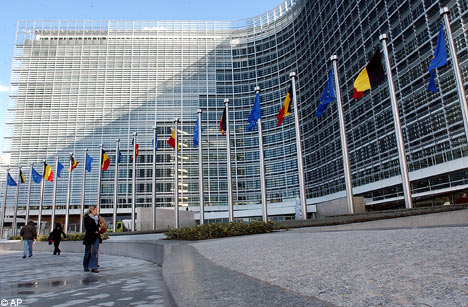
Back from Brussels


We're back from Brussels after an intense few days learning about the EU, how COMECE works and...forestry!

The trip provided us with a unique chance to understand the EU - love it or hate it - as well as see how the European machine all fits together. We saw how different groups view each other and what they do, and interestingly what the EU sees as religions role in the greater running of the European Parliament, Commission and Council.

For me one of the most fascinating chats we had was with the man responsible for religious dialogue at the European Commission - he say it as his job to let them all have a chance to contribute and air their problems. This was good. However, he also noted that they weren't allowed to talk about contentious issues such as abortion, euthanasia - as 'the EU knows their stance on these issues', I found this a bit more disheartening, that religion didn't get to logical explain our stand points.

Thankfully, the World Youth Alliance are there to fill this gap. I really enjoyed our talk by the WYA, where the members explained what they do, how they campaign and how they lobby Parliament. This direct tactic and the conviction they had was impressive and inspiring. It made me believe that Youth have a voice at the European stage on life issues.

Although we only had two days of meetings we packed a lot in!

Next we're off to visit a Prison with Fr Malachy.

Tuesday, 21 June 2011

Off to Brussels!

European Parliament
The interns are off to Brussels tomorrow to learn about the EU parliament, COMECE and see where our fellow Brussels intern has been living.


On Wednesday (22 June) we'll meet Michael Kuhn,Deputy General Secretary, Advisor for Education and Culture at COMECE along with Johanna Touzel, Press Officer for an introduction to the programme, religious organisations in Brussels and how COMECE interfaces with the EU.


After lunch at the COMECE Secretariat we grab a coffee with Wendelin Gravenreuth, Project Manager, Confederation of European Forest Owners. Then we meet Tim Foley (2md Secretary, Press and Information)

Then it's off to European Parliament where we're meeting a former intern - Rhiannon Price, who is currently working for Kay Swinburn MEP. 


Afterwards we'll meet with  Jacek Sariusz-Wolski, EPP followed by a tour of Parliament with a visit to a mini Plenary session.

To give us a flavour of a typical EU parliamentary meeting we'll attend a hearing "Connecting Europe's transport and energy infrastructures". 

Lastly we'll meet Andrew Hollingsworth, Public Affairs Manager, Novartis.

On Thursday we're off to meet Fr Frank Turner, at the Jesuit European Office followed by Iris Reinmidl, World Youth Alliance (WYA).

In the afternoon we'll off to the European Commission to discuss Dialogue with Religions, Churches and Communities of conviction, with Mr Jorge César das Neves, Adviser, Bureau of European Political Advisers (BEPA). 

The day ends with the Council of the European Union where we'll meet Mr Guy Milton who is responsible for relations between the Council and the European Parliament.

Mass ends our intern trip to Brussels, and a busy few days!
I've been to Brussels once before - as have the others - but none of us has seen the EU parliament. For the parlimentary interns this should be particularly illuminating - comparing the EU to our own parliament. Having worked so closely to our system I wonder what they will think of the EU? We'll let you know how it goes when we get back next week!

Wednesday, 20 April 2011

'Universal Catholicism' in the Maghreb and the Mashriq

Brussels Intern, Chris shares his experience of a COMECE conference.


Recently COMECE held a two day conference on the decades of diplomatic deadlock and conflicts in the Middle East and North Africa. The various speeches and debates were dedicated to Christian Churches in Maghreb and Mashriq, with COMECE Bishops warmly encouraging the citizens to continue their commitment towards the establishment of fundamental rights and democracy in the affected regions.

Seeing as the revolutions, or rather uprisings (the word revolution was concluded to insinuate the over-use of violence) were launched by the younger generation, the conference took time to pay special tribute to them, who in all the countries concerned played a leading role by initiating and organising this uprising in a courageous, peaceful and ecumenical way.

Despite their minority population, Christians in these countries share a common citizenship with their fellow citizens from other religions; each religion forms an integral part of their societies. After having had the benefit of hearing from several experts from the Arab world and
from the EU institutions, the following recommendations to were made to the EU:

- How more and concrete solidarity among the Member States of the EU is urgently needed in facing the inflow of migrants and refugees from North Africa and the Middle East.
- How the EU should help in improving the deplorable situation in these countries by developing new tools to efficiently foster modernisation and democratisation in their societies
- In the context of changes in the Arab world, how the EU should stress the importance of granting equal rights to all citizens of those countries, irrespective their ethnic or religious origin.

Throughout the conference the importance of inter-religious dialogue was clearly placed in the limelight. Dialogue should be a two-way communication, which implies speaking and listening, giving and receiving, for mutual growth and enrichment. Under the often overly brandished-about umbrella term of inter-religious dialogue is included the witness to one's own faith as well as an openness to that of the other. It was made clear how it is not a betrayal of mission of the Church, nor how it should be a new methodology of conversion to Christianity.

Finally, comments were made to the insecurity and threats that Christian minorities are ever more having to put up with in the Arab World. COMECE expressed similar concern about the way religious minorities are sometimes treated in Europe and therefore called upon all citizens, especially Christians, and the political leaders in Europe to assume their responsibilities for promoting dialogue between cultures and civilisations in Europe as well as in the rest of the world.